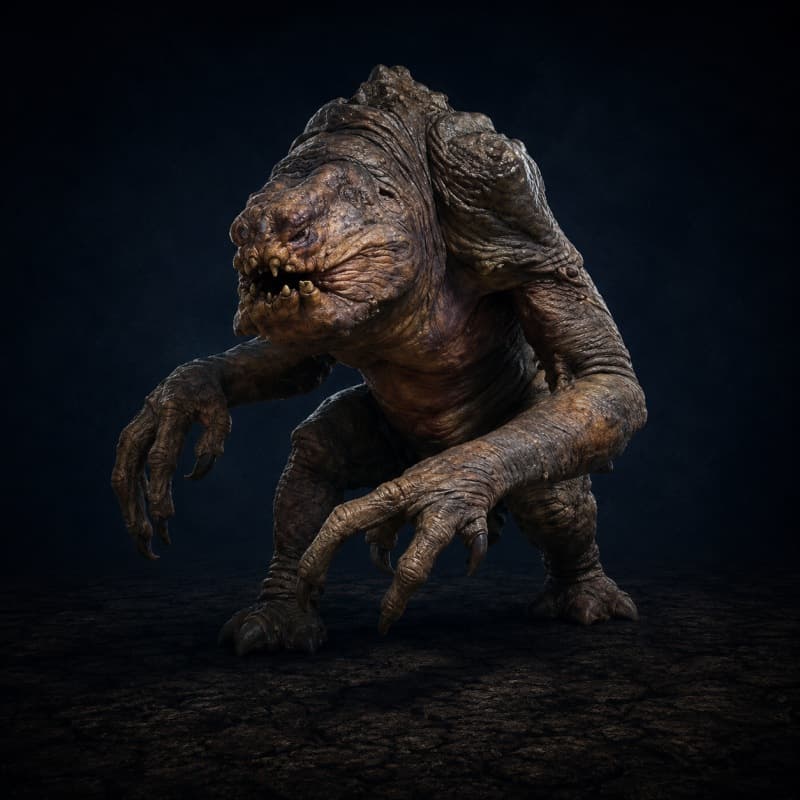
Rancor
TR 5Beast · Huge·Recommended levels: 9-14
Abilities
Saves
- STR +14
- CON +11
Skills
- Athletics +14
- Perception +6
- Survival +6
- Intimidation +9
Languages
- —
Traits
The Rancor has advantage on Strength (Athletics) checks made to Grapple, Shove, or maintain a Grapple. The Rancor can Grapple creatures up to Huge size.
The Rancor cannot be knocked Prone and has advantage on saving throws against effects that would push, pull, restrain, or move it against its will.
A creature Grappled by the Rancor is also Restrained. At the start of each of the Rancor’s turns, each creature Grappled by it takes 11 (2d10) kinetic damage.
If the Rancor is Grappling a creature, it may use its Action to throw that creature up to 30 ft to an unoccupied space it can see. The thrown creature takes 14 (4d6) kinetic damage and is knocked Prone. If it collides with a solid surface or another creature, it takes an additional 7 (2d6) kinetic damage (and the creature it collides with must succeed on a DC 16 Dexterity saving throw or take 7 (2d6) kinetic damage and be knocked Prone).
Once per Short Rest, the Rancor unleashes a bone-rattling roar. Each enemy of the Rancor’s choice within 30 ft that can hear it must succeed on a DC 16 Wisdom saving throw or be Shaken until the end of its next turn.
Actions
Lore
Rancors are legendary apex predators feared across the Star Wars galaxy—towering, thick-skinned monsters capable of tearing armored beings apart with bare hands. Most commonly associated with worlds like Dathomir and with the brutal menageries of Hutts and underworld arenas, a Rancor is the kind of creature that turns a simple mission into a survival event the moment it appears.
A Rancor is not a “big animal.” It is a walking disaster. Its massive arms and crushing grip let it seize prey, pin it effortlessly, and break resistance through raw strength and pain. Its hide is famously resilient, shrugging off punishment that would drop lesser beasts. Once a Rancor commits, it doesn’t trade blows like a soldier—it dominates space, controls targets, and decides where bodies land.
In the wild, Rancors are territorial hunters that stalk caves, ravines, jungle ruins, and deep canyon systems where they can corner prey. In captivity, they are used as living execution tools—kept hungry, provoked, and released when someone wants fear on demand. Their presence is often preceded by signs: shredded durasteel, gouged stone, half-dragged carcasses, and a silence so heavy it feels deliberate.
Game Masters should treat a Rancor as a set-piece boss creature, not random wildlife. It’s best used as the centerpiece of an arena fight, a lair encounter, a rescue mission gone wrong, or a “you should not be here” warning that forces the party to adapt fast. A Rancor battle should feel iconic: close quarters, collapsing cover, desperate rescues, and a constant threat of being grabbed, crushed, and thrown like debris.
In Play
A Rancor fights to control the battlefield, not to trade attacks. It advances into the party’s space, chooses one target, and attempts to end that target’s participation immediately. It prioritizes frontliners who step too close, wounded characters who can’t escape, or anyone who looks like a leader or healer.
The Rancor’s first goal is Grapple control. It uses its sheer reach and strength to seize prey, then relies on Crushing Hold to punish anyone caught in its hands. Once it has a creature Grappled, it forces the party into ugly choices: commit resources to the rescue, or accept that the victim is about to be broken.
Hurl Prey is the Rancor’s momentum swing. It throws targets into walls, hazards, or other characters to create chaos, knock enemies Prone, and deny formation. Use this in cinematic environments—cages, platforms, gantries, pit walls, rubble piles, hangar bays—so the throw changes the shape of the fight.
Terrifying Roar is used when the party tries to coordinate: at the start of a fight to disrupt the opening plan, or mid-fight to break a push and force hesitation. A Rancor doesn’t chase forever; it presses advantage aggressively, then re-centers on the next easiest creature to grab.
To make the encounter feel like Star Wars, lean into space pressure: narrow corridors, blocked exits, loud chains, failing doors, panicked spectators, and terrain that becomes dangerous once someone gets thrown. The Rancor should feel unstoppable—until the party outsmarts it, uses the environment, or escapes with their lives.
Adventure Hooks
- The Pit Below — A local crime lord offers the party a deal—until negotiations end with a trapdoor. The group drops into a fighting pit where a hungry Rancor has been kept as a living execution tool.
- Lair of Bones — A missing scout team’s beacon leads into a cave network littered with shattered armor and scraped stone. The party must recover survivors or intel before the territorial Rancor returns to its den.
- The Broken Menagerie — A transport carrying exotic beasts suffers a containment failure near a spaceport. Security forces lock the district down, but a Rancor is loose—and it’s hunting through maintenance tunnels and cargo lanes.
- Bait on a Chain — A desperate settlement captured a juvenile Rancor and chained it near the wall as a deterrent. Raiders cut the chain during an attack, turning the defense plan into a catastrophic three-way fight.
- The Arena Contract — A promoter hires the party for a “scripted” arena show that will make them famous. The script dies the moment the Rancor handler is killed—and the beast is released without restraints.
- Shadows of Dathomir — Rumors spread of a ‘spirit beast’ stalking an old ruin. The truth is a Rancor driven into the area by dark side disturbances, and it reacts violently to anything that approaches its claimed ground.