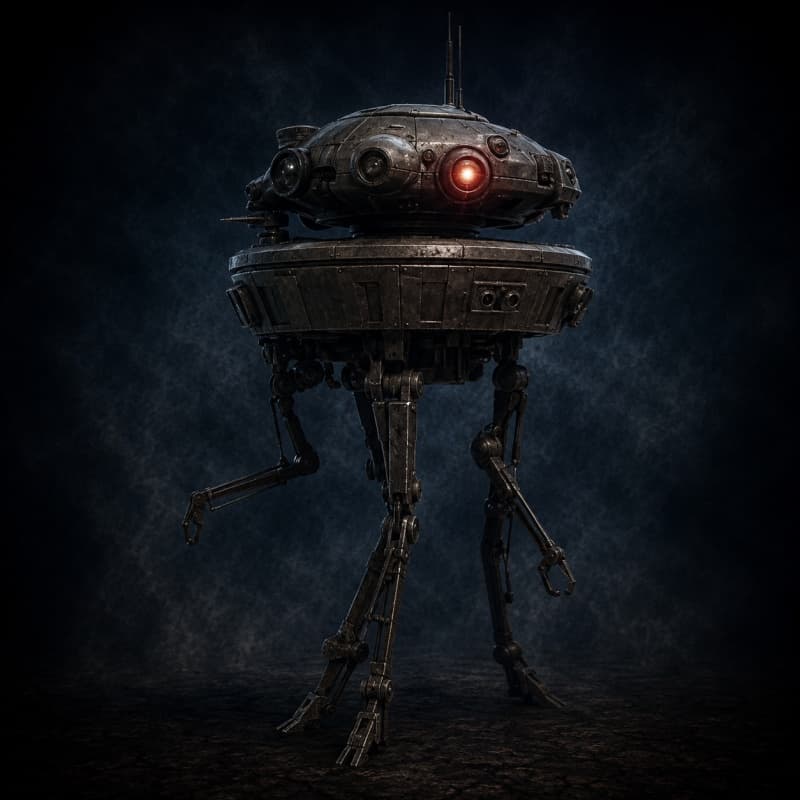
Viper-Series Probe Droid
TR 1Droid · Medium·Recommended levels: 2-4
Abilities
Saves
- DEX +4
- WIS +4
Skills
- Perception +6
- Stealth +4
- Investigation +4
Languages
- Binary
- Understands Basic (cannot speak)
Traits
The probe droid has Vulnerability to ion damage. If it takes any ion damage, it must succeed on a DC 12 WIS saving throw or become Disabled (incapacitated, speed 0) until the end of its next turn.
The probe droid has Advantage on Perception and Investigation checks that rely on sight, sound, or motion sensors.
The probe droid can hover and ignores difficult terrain. It can move through tight spaces and over obstacles as long as there is physical space to pass.
When the probe droid is reduced to 0 hit points, it detonates. All creatures within 10 feet must succeed on a DC 12 Dexterity saving throw or take 14 (4d6) energy damage, or half damage on a successful save.
Actions
Lore
Viper-Series Probe Droids are autonomous reconnaissance and interdiction units deployed to locate targets, secure territory, and relay battlefield intelligence in real time. Unlike lighter scout drones, Viper units are built to survive hostile environments long enough to complete their mission, combining advanced sensor arrays with limited onboard weaponry and a last-resort self-destruct charge.
In SWURPG encounters, a Viper probe droid represents escalation. Its arrival signals that someone powerful is watching, tracking, and reacting. The droid’s true threat is not its blaster, but its ability to gather data, mark targets, and trigger reinforcements or lockdowns. Left unchecked, it turns stealth missions into running battles and forces the party to act quickly and decisively.
For Game Masters, Viper-Series droids are perfect catalysts. They introduce urgency, deny safe hiding places, and punish indecision. Whether hovering silently through a frozen wasteland or drifting down a corridor while transmitting live feeds, a probe droid makes the environment feel hostile and alive — and reminds players that delay has consequences.
In Play
Viper-Series Probe Droids prioritize observation over engagement. They remain mobile, hovering above terrain and obstacles to maintain line of sight and sensor coverage. When encountering resistance, they harass targets with blaster fire while repositioning to safer angles, buying time to transmit data or summon support.
At the table, use the probe droid to force momentum. It should appear early, act quickly, and retreat or reposition rather than stand and trade fire. If cornered or critically damaged, the droid detonates without hesitation, turning its destruction into a final hazard. Players should learn that ignoring a probe droid is often more dangerous than fighting it.
Adventure Hooks
- Eyes in the Snow — A Viper-Series Probe Droid crashes near a remote settlement and begins scanning the area. Imperial forces will arrive soon — unless the party destroys the droid before it finishes transmitting its findings.
- Marked for Retrieval — After a brief encounter with a probe droid, the party realizes they are being tracked across multiple systems. Each jump brings new hunters closer as the droid’s data circulates through hostile networks.
- Silent Corridor — A probe droid patrols a derelict station, drifting silently through zero-gravity corridors. Its sensors ignore darkness and cover, turning the station into a deadly game of cat and mouse.
- Self-Destruct Protocol — A damaged probe droid activates its detonation sequence while trapped in a confined space. The party must decide whether to flee, disable it, or use the explosion to their advantage.
- False Transmission — A rebel cell asks the party to capture a Viper probe droid intact and alter its data stream, feeding false intelligence to Imperial command to lure enemy forces into a trap.