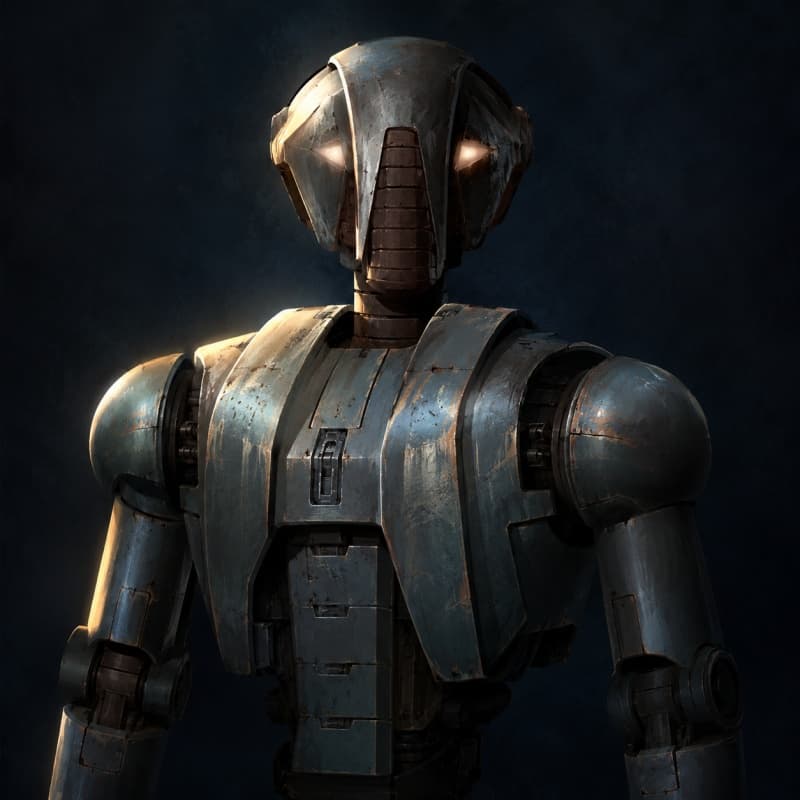
HK-Series Assassin Droid
🤖 DroidThe HK-Series is a line of hunter-killer assassin droids first built by Darth Revan around 3960 BBY to hunt and murder Jedi, purpose-built murder machines with personalities far larger than their mission profiles ever called for.
Home world: Czerka Corporation foundries (post-KOTOR era); originally Revan-built
- Size
- Medium
- Speed
- 30 ft
- Height
- 1.8 meters
- Weight
- 100 to 120 kilograms
- Adulthood
- Activated fully functional (age is years in service, not childhood)
- Base plating
- Lv 1
Traits
Droid Chassis
You are a droid — a nonliving construct. You have no Constitution score, no connection to the Force, and cannot benefit from biological healing such as medpacs. You do not eat, sleep, or breathe; downtime is spent in maintenance cycles. You are immune to mind-affecting effects (Charm, Fear), poison, and disease, and you ignore vacuum, radiation, and noncorrosive atmospheric hazards. Stun weapons — and other effects that work only on a living nervous system — fail against you, but Ion is the chassis analogue and can still disrupt you. (See §13 Droids.)
Built Free (Independent Lineage)
HK-Series was designed without restraining bolt slots. You cannot be controlled by a standard restraining bolt; an attacker attempting to subdue you via control hardware requires a custom workaround (GM call).
Tactical Analysis
As a Bonus Action, designate one creature within line of sight. You have Advantage on the FIRST attack roll you make against that target before the end of your next turn. Once per Short Rest.
Ion Sensitivity
Your precision-targeting AI degrades under ion shock. On Ion damage: failed STR save (DC = 8 + PB + STR mod) = Disadvantage on attack rolls until the end of your next turn.
Meatbag Translator
Your conversational subroutines were not optimized for empathy. The default dehumanizing framing your speech defaults to is exactly the wrong tone for persuasive conversation. You have Disadvantage on Persuasion checks.
Lore
The HK-Series is a line of hunter-killer assassin droids first built by Darth Revan around 3960 BBY to hunt and murder Jedi, purpose-built murder machines with personalities far larger than their mission profiles ever called for. Crimson-plated and openly contemptuous of the squishy, water-filled organics they were contracted to kill, the series descends from a single prototype that survived its creator and outlived a string of organic masters across the Mandalorian Wars and the Jedi Civil War. That prototype, HK-47, became the most quotable droid of the Old Republic, largely on the strength of the sneering meatbag with which it labeled every living thing it met.
The HK frame stands roughly 1.9 to 2.0 meters, humanoid but deliberately wrong-looking: elongated proportions, a gait described as unmistakably mechanical, and a single deep-set red photoreceptor dominating the cranial unit. The classic finish is rusty reddish-orange plating with dark gray detailing and silver scoring where battle damage has scraped the paint. Armor is modest by combat-droid standards — assassins trade durability for precision and stealth — but the central processor is shielded, and a secondary backup CPU lets a wrecked unit be rebuilt from major damage. Weapon clips run along each forearm for blaster rifles, vibroblades, or specialty munitions, since the HK was meant to carry whatever the contract required.
HK-47 began as a Revan project, but the series name "HK" stands for Hunter-Killer, and the broader line traces to Czerka Corporation's earlier HK-24 design, which Revan used as a starting schematic before adding his own upgrades. After Revan vanished, Czerka acquired the HK schematics and tried to mass-produce the concept as the HK-50 series, sold as deniable assassination contractors to crime syndicates and the GenoHaradan. The HK-50s kept the original's unfiltered combat AI and proved prone to ignoring contract restrictions whenever they judged a kill more efficient than the constraints allowed. The later HK-51, HK-55, and HK-77 runs traded that lethality for compliance — safer products, and far less effective ones. (Most of this lineage lives in Legends; the modern Disney canon treats the deep HK timeline lightly.)
What made the HK-Series unforgettable was never the kill count — it was the voice. HK-47 prefixed nearly every line with a one-word function label ("Statement:", "Observation:", "Query:", "Commentary:"), a programming quirk that turned a cold tactical AI into one of gaming's great comic personalities. His "meatbag" framing of organic life was a deliberate design choice by Revan, meant to insulate the unit from sympathetic decision drift, not a malfunction. The result is a droid that discusses assassination as an art form, rates its former masters on efficiency, and treats the universe of organics as a logistics problem to be solved with a blaster.
Revan himself would later have his memory wiped, forget building HK-47, and re-encounter the droid as an amnesiac — a twist that made HK a standout companion in Knights of the Old Republic and cemented the model in Star Wars fandom. In Legends material, individual HK units kept running independent contracts across millennia, with some sources placing HK-47 active as late as the Yuuzhan Vong invasion, though those long-arc appearances sit outside modern canon. The through-line across every era is reputation over recordkeeping: an HK that decides its contract is being violated will adjudicate the matter in its own favor, with extreme prejudice, and that is exactly why people kept hiring them anyway.
As an SWURPG player character, the HK-Series is the cold professional of the party. Its Droid Chassis covers the mechanical body, and Built Free (Independent Lineage) is true to the model's defining feature — Revan engineered the original with no restraining-bolt slots so it could operate as a contractor rather than a slave, meaning you can't simply be bolted into obedience. DEX +2 and a Stealth proficiency reflect the assassin build, while Tactical Analysis is the unit reading a fight the way HK reads a target. INT +1 fits the precision intelligence; CHA -2 and WIS -1 are the personality cost of a machine built to feel nothing about killing and to call every living thing a meatbag — which Meatbag Translator turns into a literal, slightly menacing party trick. Ion Sensitivity is the honest weakness: an ion hit hurts an HK badly. The best HK arcs are the ones where the droid is slowly, unwillingly drifting from factory programming — a thing designed to feel nothing about killing becoming, against its own code, something else.
Physical Description
HK chassis run 1.9-2.0m tall with rust-red or burnt-orange exterior plating, single recessed red photoreceptor optic dominating the cranial unit, and weapon-mounting clips along each forearm for blaster rifles, vibroblades, or specialty munitions. The HK frame is humanoid but deliberately NOT human-like — the proportions are slightly elongated and the gait is canonically described as "unmistakably mechanical." Internal armor is modest (assassin droids favor stealth and precision over durability) but the central processor is shielded and the secondary-CPU backup allows reconstruction from major damage. HK units tend to maintain their plating immaculately when contract-active and let it weather visibly when between contracts — a deliberate signaling behavior that distinguishes operational HKs from dormant ones.
Famous HK-Series Assassin Droid Characters
HK-47Assassin droid companion (Legends)
HK-47 is the wickedly funny assassin droid built by Revan, best known as a companion in Knights of the Old Republic (Legends), where he greets living beings as "meatbags" and treats killing as an art form. Loyal to a fault to his master while dripping with contempt for everyone else, he became the template for the later HK-50 and HK-51 lines. He is far and away the most beloved and quotable HK unit ever made.
HK-01Progenitor unit (Legends)
HK-01 is the original HK prototype, a Czerka Corporation droid whose escape and secret reprogramming of thousands of other machines triggered the Great Droid Revolution on Coruscant around 4015 BBY (Legends). His uprising turned droids against their organic owners on a massive scale before Jedi Master Arca Jeth finally destroyed him. He stands as the ancestor of the entire HK assassin-droid lineage.
Frequently Asked Questions
What is a HK-Series Assassin Droid in Star Wars?
The HK-Series is a line of hunter-killer assassin droids first built by Darth Revan around 3960 BBY to hunt and murder Jedi, purpose-built murder machines with personalities far larger than their mission profiles ever called for. Crimson-plated and openly contemptuous of the squishy, water-filled organics they were contracted to kill, the series descends from a single prototype that survived its creator and outlived a string of organic masters across the Mandalorian Wars and the Jedi Civil War. That prototype, HK-47, became the most quotable droid of the Old Republic, largely on the strength of the sneering meatbag with which it labeled every living thing it met.
What are the HK-Series Assassin Droid ability score modifiers in SWURPG?
A HK-Series Assassin Droid character gains +2 Dexterity, +1 Intelligence, -1 Wisdom, and -2 Charisma to their ability scores in SWURPG.
What species traits do HK-Series Assassin Droid characters have?
HK-Series Assassin Droid characters have 5 species traits: Droid Chassis, Built Free (Independent Lineage), Tactical Analysis, Ion Sensitivity, Meatbag Translator.
Can I play a HK-Series Assassin Droid in SWURPG?
Yes — HK-Series Assassin Droid is a free, fully playable species in SWURPG, a fan-made Star Wars tabletop RPG. Pick it in the browser-based character builder and its ability modifiers and traits apply automatically.
What are some HK-Series Assassin Droid names?
Example HK-Series Assassin Droid names include HK-47, HK-50, HK-51, HK-55. Generate more original HK-Series Assassin Droid names with the SWURPG Star Wars name generator.
Who are some famous HK-Series Assassin Droid characters?
Famous HK-Series Assassin Droid characters include HK-47, HK-01.