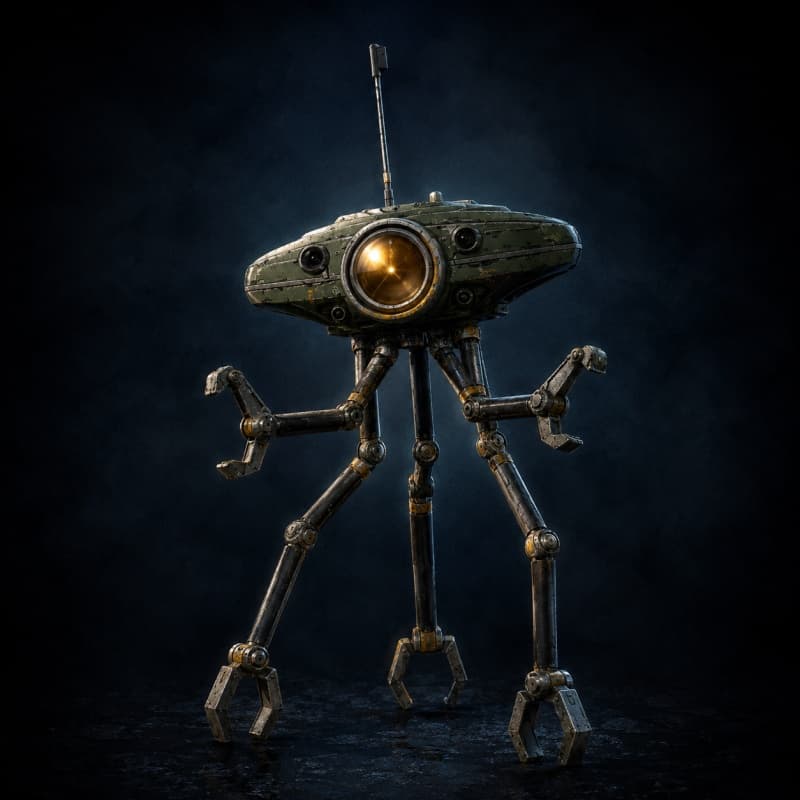
ID9 Seeker Droid
🤖 DroidThe ID9 Seeker Droid is a compact reconnaissance-and-harassment droid manufactured by Arakyd Industries, the same firm behind the Viper-line probe droids it so obviously descends from, known for scouting corridors, cornering targets, and reporting back so its handler can close in for the kill.
Home world: Arakyd Industries (manufacturer; production primarily in Imperial-affiliated facilities)
- Size
- Tiny
- Speed
- 30 ft
- Height
- 0.4 to 0.6 meters (dome diameter)
- Weight
- 8 to 14 kilograms
- Adulthood
- Active immediately upon assembly; no developmental phase
- Base plating
- Lv 0
Traits
Droid Chassis
You are a droid — a nonliving construct. You have no Constitution score, no connection to the Force, and cannot benefit from biological healing such as medpacs. You do not eat, sleep, or breathe; downtime is spent in maintenance cycles. You are immune to mind-affecting effects (Charm, Fear), poison, and disease, and you ignore vacuum, radiation, and noncorrosive atmospheric hazards. Stun weapons — and other effects that work only on a living nervous system — fail against you, but Ion is the chassis analogue and can still disrupt you. (See §13 Droids.)
Hover Locomotion
You can switch between hover mode and ground-crawl mode as a Free Action. While hovering (up to 5 ft above the surface), you ignore difficult terrain and water/swamp/oil-slick movement penalties, and you do not trigger ground-pressure traps. While crawling, your low silhouette grants you an additional +2 to Stealth checks against creatures more than 10 ft away.
Vocal Mimicry
Your audio synthesizer can reproduce the voice patterns, droid-Binary cadences, and mechanical sounds of any droid model you have observed for at least one minute. Useful for impersonating Imperial scout droids, fooling voice-locked doors, decoying enemy droids, or relaying false orders. The trait is narrative — Deception or Use Computer checks are still rolled normally per the GM's call.
Integrated Photoreceptor Blaster
A compact blaster emitter is built into the center of your photoreceptor housing. It counts as a Light blaster (1d6 Energy damage, 30 ft range, integrated to your chassis). You are always proficient with it and cannot be disarmed of it. Because the emitter is built into a sealed sensor housing, it cannot be fitted with removable-hardware upgrades (scope, barrel extender, etc.) — only firmware-level weapon upgrades the GM rules as compatible. Power cells regenerate during your downtime maintenance cycle.
Ion Sensitivity
Ion damage scrambles your sensor cluster and audio synthesizer. On Ion damage: failed STR save (DC = 8 + PB + STR mod) = Blinded until the end of your next turn (you cannot use sight-based senses, automatically fail sight-based checks, attack rolls against you have Advantage, your attack rolls have Disadvantage).
Expressionless Chassis
Your hemispherical dome and single fixed photoreceptor cannot produce facial expressions, microsignals, or the warmth-cues that organic conversation depends on. You have Disadvantage on Persuasion checks. Intimidation is unaffected — a red sensor staring an organic down is canonically unsettling, and the chassis's Imperial-coded silhouette amplifies the effect — and Deception remains rollable since your Vocal Mimicry handles vocal-tonal deception (no microexpressions to give your bluff away either).
Lore
The ID9 Seeker Droid is a compact reconnaissance-and-harassment droid manufactured by Arakyd Industries, the same firm behind the Viper-line probe droids it so obviously descends from, known for scouting corridors, cornering targets, and reporting back so its handler can close in for the kill. Palm-to-helmet-sized and cheap enough to deploy by the handful, the ID9 did the legwork of an Imperial manhunt, most famously in the hands of the Inquisitorius: where the Seventh Sister walked, a swarm of seekers floated at her shoulders, plucked one by one from the rack on her armor and sent ahead to find Jedi for her to kill, so that by the time she arrived her prey was already half-trapped.
An ID9 is a single half-hemisphere dome with one large red photoreceptor staring out of it, mounted over five articulated tentacle-like limbs that taper to pincers. The whole thing reads like a probe droid shrunk down to a personal tool, which is roughly what it is. It moves two ways: hovering on a repulsorlift for silent sweeps, or folding down to crawl on those pincered limbs when it needs to creep along a floor or grip a surface. The center of the photoreceptor hides a small blaster, and the limbs carry electro-shock prods that hurt organic targets and short out mechanical ones, which is how a single seeker can drop a flesh-and-blood rebel and an astromech in the same fight.
The model is an Arakyd Industries product, the same firm behind the Viper-line probe droids the ID9 so obviously descends from. Arakyd built the seeker as a compact reconnaissance-and-harassment unit rather than a long-range probe, trading the Viper's deep-space endurance for a body small and cheap enough to deploy by the handful. They saw real use in the early Imperial era, most famously in the hands of the Inquisitorius, where their job was less "gather intelligence" and more "find the Force-user and keep them busy."
Two features set the ID9 apart from a plain probe. The first is its audio recording, which lets it capture and store the sounds around a target. The second, built on top of that, is vocal mimicry: an ID9 can reproduce the noises of other droid models well enough to be mistaken for one, a trick that earned the line its nicknames "Parrot Droid" and "Mimic Droid." A seeker that sounds like a friendly astromech can roll up on an enemy who never reaches for a weapon until the prods are already out.
Their best-known outing is the Star Wars Rebels episode "Always Two There Are," where the Seventh Sister turned a swarm of ID9s loose inside an abandoned Republic medical station to flush out Ezra Bridger and the rest of the Spectres. One seeker spotted a rebel and reported it; another ambushed and knocked out the astromech Chopper. That sequence is the ID9 thesis in miniature: the droids aren't there to win the fight themselves, they're there to scatter, distract, and pin the targets so their master can finish the job. The Seventh Sister built her whole hunting style around them, which is why she carried seekers on her back where another Inquisitor would clip a spare lightsaber.
In SWURPG you're playing the seeker itself, and the kit leans into the surveillance role. The Droid Chassis and Expressionless Chassis traits give you the synthetic frame and unreadable single-eye face, Hover Locomotion is the repulsorlift sweep, and Vocal Mimicry is the literal Parrot-Droid trick for bluffing your way past anyone who trusts a familiar droid sound. The Integrated Photoreceptor Blaster is the weapon hidden behind the red eye, and Ion Sensitivity is the honest downside of a small, lightly built machine that the canon shows getting knocked out of fights fast. Mechanically you're fragile and weak (str -4) but quick and precise (dex +2), and the Perception and Stealth proficiencies make you exactly what an ID9 is meant to be: the scout that finds the target before anyone realizes they've been found.
Physical Description
ID9 chassis are Tiny — the hemispherical dome housing is roughly 40 to 60 centimeters in diameter, with the five articulated tentacle limbs extending another 30 to 40 centimeters when fully unfurled. The chassis is dominated by a single large red photoreceptor at the center of the dome, which doubles as the housing for the integrated blaster emitter. Five flexible tentacle limbs project from the underside of the dome, each terminating in a small two-fingered pincer suited for both manipulation and gripping. The locomotion package is dual-mode: a compact repulsorlift underneath the dome provides quiet hover up to roughly one meter above the surface, while the tentacle limbs allow surface contact for climbing, crawling, and bracing in confined spaces. Plating is typically dark grey or matte black with subtle red sensor accents; some refurbished units repaint in neutral civilian colors to obscure the Imperial origin.
Culture & Personality
Factory-fresh ID9 units arrive with a programmed disposition matrix designed for sustained surveillance work — patient, methodical, reporting-oriented, with no developed individuality beyond what the handler imprints. After extended deployment, however, ID9 personality matrices tend to drift: the chassis's natural sensor and audio-mimicry capabilities give the unit an enormous range of social inputs to model from, and units that survive long enough to log significant runtime almost always develop quirks, preferences, and habits their original Imperial handlers would consider drift errors. A playable ID9 PC has typically experienced precisely this drift — far enough that the unit is no longer reliable as an Imperial asset, but recently enough that the original tactical conditioning still informs its instincts.
In adventuring parties, ID9 PCs naturally gravitate toward the scout, infiltrator, and surveillance roles. The chassis's combination of Tiny size, hover locomotion, and high baseline Stealth makes the unit very hard to detect; the integrated blaster and audio mimicry let the unit handle the occasional combat or social encounter without depending entirely on the party. The roleplay tension comes from outside: organic NPCs may not know what to make of a small Imperial-coded surveillance droid that talks to them, and even an ID9 with a fully drifted personality matrix is still a unit that was built specifically to find and report on people exactly like them.
Frequently Asked Questions
What is an ID9 Seeker Droid in Star Wars?
The ID9 Seeker Droid is a compact reconnaissance-and-harassment droid manufactured by Arakyd Industries, the same firm behind the Viper-line probe droids it so obviously descends from, known for scouting corridors, cornering targets, and reporting back so its handler can close in for the kill. Palm-to-helmet-sized and cheap enough to deploy by the handful, the ID9 did the legwork of an Imperial manhunt, most famously in the hands of the Inquisitorius: where the Seventh Sister walked, a swarm of seekers floated at her shoulders, plucked one by one from the rack on her armor and sent ahead to find Jedi for her to kill, so that by the time she arrived her prey was already half-trapped.
What are the ID9 Seeker Droid ability score modifiers in SWURPG?
An ID9 Seeker Droid character gains -4 Strength and +2 Dexterity to their ability scores in SWURPG.
What species traits do ID9 Seeker Droid characters have?
ID9 Seeker Droid characters have 6 species traits: Droid Chassis, Hover Locomotion, Vocal Mimicry, Integrated Photoreceptor Blaster, Ion Sensitivity, Expressionless Chassis.
Can I play an ID9 Seeker Droid in SWURPG?
Yes — ID9 Seeker Droid is a free, fully playable species in SWURPG, a fan-made Star Wars tabletop RPG. Pick it in the browser-based character builder and its ability modifiers and traits apply automatically.
What are some ID9 Seeker Droid names?
Example ID9 Seeker Droid names include ID9-71, ID9-Black-3, ID9-Argus, ID9-Echo-Seven, ID9-Veridian, ID9-Listener. Generate more original ID9 Seeker Droid names with the SWURPG Star Wars name generator.