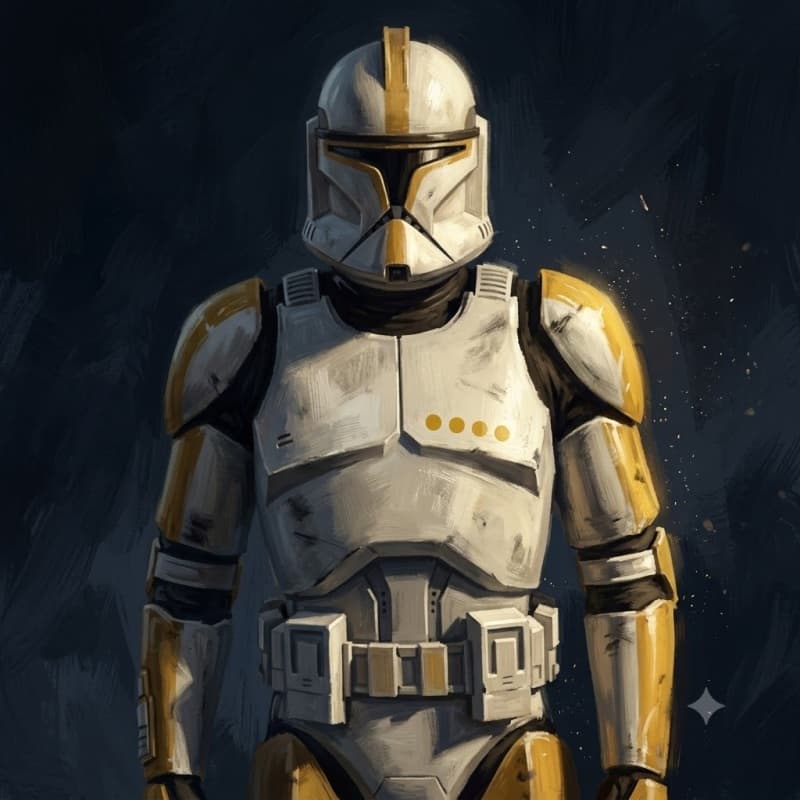
Clone Commander
TR 6Humanoid · Medium·Recommended levels: 9-14
Abilities
Saves
- CON +7
- WIS +7
- CHA +7
Skills
- Knowledge: Tactics +12
- Persuasion +7
- Insight +7
- Perception +7
- Athletics +6
Languages
- Mando'a
- Galactic Basic
Equipment
Traits
Allied clones within 30 feet of the commander that can see and hear it gain a +2 bonus to their attack rolls and saving throws. (The Officer *Battlefield Leadership* feature.)
Allies within 30 feet of the commander can't be frightened, and the commander itself has advantage on saving throws against being charmed or frightened.
The commander can't be surprised while conscious, rolls initiative with advantage, and can take one additional reaction each round.
(Bonus Action) One allied clone within 30 feet immediately moves up to half its speed without provoking opportunity attacks. (The Officer *Tactical Orders* feature.)
(Bonus Action) The commander marks one creature it can see within 60 feet. Until the start of the commander's next turn, allied clones deal an extra 1d6 damage to that target on a hit. (The Officer *Designated Assault* feature.)
Once per turn, when the commander hits with a ranged attack, the next two allies to attack that creature gain +2 to hit and +2 damage against it.
The commander has advantage on death saving throws and on saves against being stunned; the first time each combat it would drop to 0 HP, it instead drops to 1 HP.
Actions
The clone commander makes two attacks with its DC-15A blaster rifle.
(Bonus Action) The commander designates a target it can see within 60 feet. One allied clone within 30 feet may immediately make one weapon attack against that target as a reaction, with advantage.
(Recharge 5-6) Each allied clone within 30 feet gains 9 (2d8) temporary hit points and may immediately end one of the following conditions on itself: frightened, prone, or stunned. (Modeled on the Officer *Rallying Words* feature.)
Lore
Clone commanders — Cody, Rex, Bly, Gree, Wolffe, Fox — are the men the Jedi generals actually fought beside: veteran clones, marked out early for initiative and command, who ran battalions and legions and carried the weight of every trooper under them. A commander is dangerous less for his own rifle than for what he does to a battlefield: he sees the whole board, moves his men a beat ahead of the enemy, and turns a clone unit from a collection of good soldiers into a single, ruthless instrument.
Commanders are the clones who became most fully themselves. Given real authority and the trust of their generals, they painted their armor, customized their kit, took names that meant something, and forged the kind of bond with their Jedi that made what came later so monstrous. The best of them were brilliant tacticians and decent men in an indecent war — which is exactly why Order 66 used their discipline against them, turning the soldiers who would have died for their generals into the ones who shot them in the back.
In Play
Never run a commander alone — its threat is multiplicative. Surround it with clones so Command, Coordinated Strike, Tactical Orders, and Rally are always paying off, and the whole unit fights a full tier above its numbers. The commander itself stays mobile and protected, directing fire, repositioning its men, and shrugging off the first thing that goes wrong (Seasoned Survivor). Kill or isolate the commander and the squad's coordination collapses — that's usually the party's best plan. As an ally, a commander is the NPC who makes a desperate battle feel winnable.
Adventure Hooks
- The General's Right Hand — A clone commander asks the party to do quietly what the chain of command won't sanction — extract a captured brother, or bury evidence that would cost his Jedi general her command. His loyalty is to his men first, and he's gambling the party shares it.
- After the Order — Post-Order 66, a commander who executed his Jedi general is hunting the survivors — and is beginning, in his rare clear moments, to suspect that the order was never his own. The party can run, fight, or try to reach the man buried under the chip.