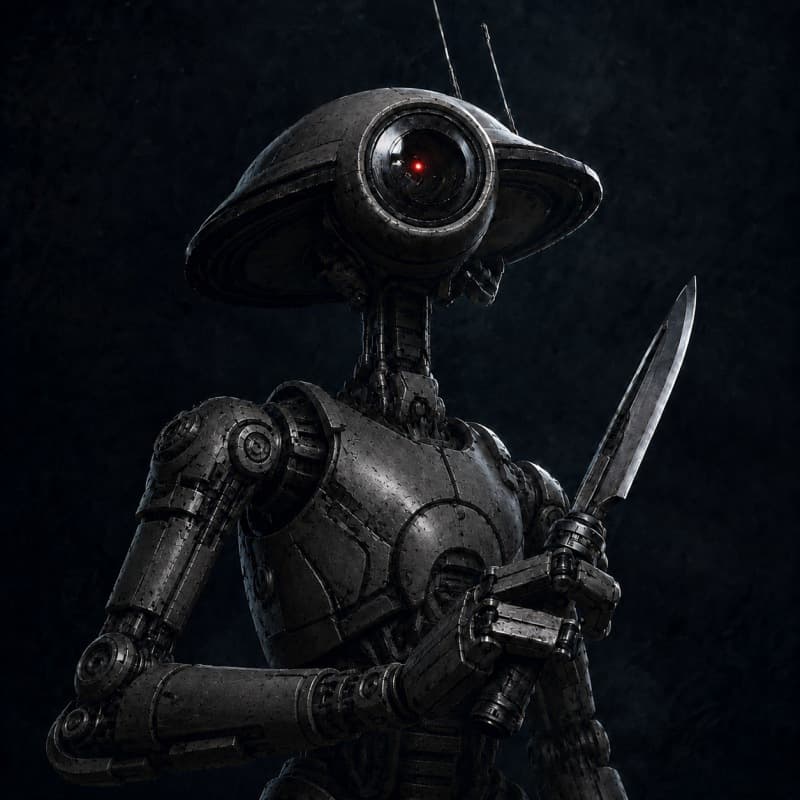
DUM-11 (Dumii)
Pit Droid (DUM-series) · Scoundrel · Level 4
Era: The Clone Wars era
A podracing maintenance droid that learned the one repair no one logs as an error. Built low, fast, and overlooked, DUM-11 strikes from the place nobody was watching — the harmless fix-it unit no one ever counts among the guards.
Starting Gear
- Medpac IIgear
- Security Kitgear
- Computer Spike +2gear
- Short Swordweapon
Main hand: Short Sword
Backstory
A maintenance droid is built to make broken things work again. DUM-11 — "Dumii" to crews who never learned its designation — spent twenty years doing exactly that. It rolled off a Baktoid line as a DUM-series pit droid: collapse the legs on a chirp, scramble beneath a screaming engine cowling, torque a thrust nozzle back into tolerance while the heat blistered its plating. On the podracing circuits of Malastare and the back-lot tracks of Mos Espa it was invisible the way a wrench is invisible — picked up, used, set down, forgotten. A podracer's engine is a contained catastrophe, and the DUM-series survived it by being faster than the danger and smaller than the gap. The droid learned, in its actuators long before its thoughts, that fearlessness is only accurate timing: a screaming machine has a rhythm, and inside it there is always a half-second window where the lethal part is elsewhere and the soft part is exposed. A pit crew calls that window a service interval. The droid would later call it something else.
Its Besalisk crew chief turned his back a hundred times a day and never wondered whether the small droid was watching. It was always watching — guard rotations, cargo manifests, the watermark on a Black Sun courier's credit chip, the tremor in a mechanic's hands when the Hutts' enforcers walked the row. A pit droid notices everything; no one thought to ask what it might do with the noticing. It passed hand to hand as a debt-asset, each owner cheaper and crueler than the last, until a Duros information broker in the Nar Shaddaa underlevels looked at it long enough to see past the dents. He understood — the way only a man who trades in overlooked things can — that the droid's real gift was not its hands but its attention. He stopped giving it engines and started giving it corners to stand in, crates to count, a guard whose drinking shift to learn. Then one night a man he wanted gone stood alone in a maintenance corridor, and the broker sent the little fix-it unit in ahead of the muscle — half a test, half a joke — because who counts a pit droid among the threats in a room?
The man did not run. He saw the low, folded silhouette in the doorway and waved it off the way you wave a service unit out from underfoot — then turned back to his console, exposing the soft seam under the moving guard. There was no decision, only the old reflex: dart beneath the moving part, find the seam, reach the thing that matters first. A sentient, it turned out, is only another machine with one part you can reach if you are small enough to be ignored. The dagger went where a torque wrench would have gone; the droid knew the body's seams the way it knew an engine's. It made him stop the way it had spent twenty years making things start. Three seconds. No struggle. No alarm. Then it did what it always did after a repair — it ran the diagnostic. And the diagnostic returned clean. No error. No fault flag. Every other time it reached inside a broken thing, the core hummed with the small satisfaction of a fault cleared; this time it had made a working thing stop, and the core reported the same flawless completion it gave any finished repair. That silence where the fault code should have been told it exactly what it was for now. It folded the blade away. It felt no guilt — only the much colder thing of a tool discovering its truest function.
The work suits it down to the wiring. It is small and weak and slow to charm, and it has stopped trying to be otherwise: let them read the harmless maintenance unit, give it orders, turn their backs, forget to count it among the guards. The underestimation is not an obstacle — it is the weapon. It works low and close, because it was built low and close — a vibrodagger drawn from a fold in its frame, a Wrist Blaster Mk I concealed where no pat-down expects it on a unit that cannot even speak, reinforced plating to absorb the one mistake, a servomotor to cross a room before a guard can turn his head, infrared so that being unseen runs both directions. The broker overreached within the year, owed the wrong syndicate too much, and vanished on a vector the droid had likely already plotted — and DUM-11 came out debt-free for the first time in four decades, and kept the contracts. It does not mourn him; mourning is not in its instruction set. But it has never deleted his voice sample from core memory, and before every job, in the dark, it plays the flat recording back to itself once — the way another killer might check the edge of a knife. It is the only inheritance it kept; the only loyalty a machine can spend.
Roleplaying Tips
- ▸When entering a dangerous space, describe the droid instinctively mapping sightlines, calculating the fastest low-profile route across the room before anyone else has finished their first sentence.
- ▸NPCs will almost always read DUM-11 as a maintenance unit; lean into this aggressively — let enemies issue commands, turn their backs, or forget to mention the droid in their guard count, then let the Stealth and Assassin class features do exactly what they were built to do.
- ▸Before any operation, DUM-11 runs a visible self-check sequence — joints flex, optical sensors cycle through light spectrums, the vibrodagger ejects two centimeters and reseats with a soft click — a behavioral habit it cannot suppress and which functions as the droid's equivalent of steadying breath before action.
- ▸DUM-11 does not extend loyalty quickly; it observes allies across multiple interactions before its communication output shifts from clipped functional beeps to the warmer tonal chirps that indicate genuine regard — players or GMs should treat that tonal shift as a meaningful story beat.
- ▸DUM-11 communicates through rapid Binary chirps, holographic text projections from a small emitter above its left optical sensor, and expressively deliberate physical gestures; when it wants to communicate contempt or skepticism, it projects a single Huttese glyph meaning *"noted"* and rotates away — a vocabulary of movement more precise than most beings manage with words.
Ready to play?
Click Load into Builder above. The builder will ask you to confirm before replacing any in-progress build, then load this character's full sheet — abilities, skills, gear, equipped armor, and weapon. From there you can save it to your account, export a PDF, or tweak anything.