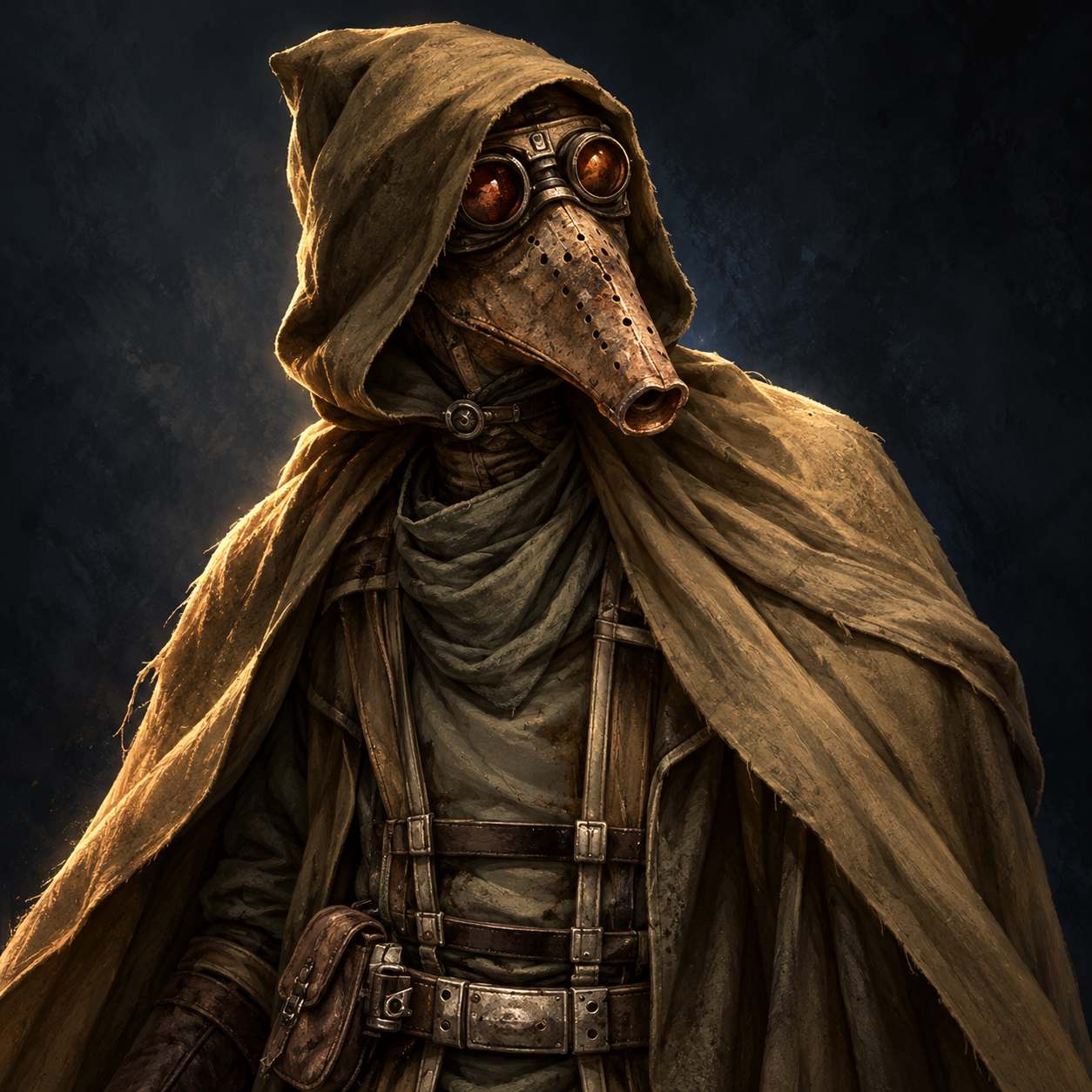
Kubaz
Kubaz are an insectivorous species from Kubindi, known for the prehensile snouts they use to raid insect hives, for clan farms that turned insect-breeding into a planetary industry, and for a spy reputation the Empire manufactured and sold back to the galaxy.
Home world: Kubindi
- Size
- Medium
- Speed
- 30 ft
- Height
- 1.7 to 2.0 meters
- Weight
- 60 to 90 kilograms
Traits
Red-Blind Eyes
Kubaz eyes are tuned to the long red end of the spectrum and handle darkness better than almost anyone's. You have darkvision out to 60 feet. Bright light is the bill: when you are suddenly exposed to it, you have Disadvantage on attack rolls and on sight-based Perception checks, and unlike most such effects it does not pass on its own. It lasts until you spend 10 minutes in darkness or get protective lenses over your eyes.
Probing Snout
The long, flexible Kubaz snout evolved to reach down a hive tunnel and pull out what was hiding at the end of it. The same instinct works on a cargo crate, a wall cavity or a body. You gain proficiency in Investigation.
Bought and Sold
Kubaz trade information the way their clans trade beetles, and an offworld Kubaz usually knows someone who knows. Once per Long Rest, you may reroll a failed Knowledge: Galactic Lore check made to learn who someone is, who they work for, or where they have been.
Lore
Kubaz are an insectivorous species from Kubindi, known for the prehensile snouts they use to raid insect hives, for clan farms that turned insect-breeding into a planetary industry, and for a spy reputation the Empire manufactured and sold back to the galaxy. Reference works cannot agree on what to file them as: the same catalogs that call them insectoid also describe them as elephantine and mammalian, which says less about Kubaz biology than about how strange they look to anyone raised on a wetter, dimmer world. They lived in clans, they spoke in whirring syllables, and before the Empire arrived most of them had little interest in leaving home.
Physically they are bipedal and broadly mammalian, standing between 1.7 and 2 meters, with rough green-black skin, short bristly hair on the scalp, and two-toed feet. The snout is the whole species in one organ: short, prehensile, trunk-like, built to push into a hive and withdraw prey, and doubling as an extremely sensitive nose. Behind it sit two rows of teeth. The eyes are the vulnerability. Kubindi orbits a blue giant, and Kubaz vision evolved under that light, leaving them acutely sensitive to red wavelengths; travel to a world lit by a red or yellow star and a Kubaz needs protective eyewear or the glare is punishing. (No source describes Kubaz infrared vision, whatever the goggles imply.)
Kubindi sits in grid square T-9 of the Outer Rim Territories, in the Calaron sector, in a system recorded both as the Ku'Bakai system and simply as the Kubindi system. It was once a forested world. Its blue giant primary put an end to that: solar flares scoured the surface, leaving much of the planet as scorched rock with no vegetation above ground and weather erratic enough to be useless to plan around. The Kubaz answer was to go down. They built hive-mounds, then, as conditions worsened, enormous hives inside mountain caves and cavern systems, following the insects deeper as they went. Clans lived in those underground nests under matriarchal queens, and each clan took the name of the queen it descended from.
Insects are not a quirk of the Kubaz diet, they are the economy. Hunting gave way to farming, and farming gave way to insecticulture, the Kubaz term for genetic engineering applied to food insects - breeding them to reproduce faster, grow larger, and taste better. That same science ended a war. When clans dug into one another's territory chasing harvests, raids on rival insect farms escalated into the Hive Wars, and the conflict was settled less by treaty than by husbandry: engineered stock made raiding pointless, and clans color-coded their own insects so no hive could claim a neighbor's swarm by mistake. What came out of all that was high cuisine. Kubindi's largest export was its cooking rather than its livestock: termytes, picolet beetles (Garindan's clan farmed a strain other Kubaz called succulent), filleted decaleg, buzzworms brought in from Haruun Kal. Gardulla the Hutt kept a Kubaz chef who specialized in insects bred for size and flavor, and in Legends the Imperial admiral Spitar P'ton hired an entire Kubaz kitchen staff and carried the food into elite Imperial circles alongside Kubaz art and theater. Domestic life ran through the eldest: ordinary family business was decided by the first-born, the First, advised by the next two siblings, the Second and the Third, the group collectively called the Three, with elders semi-retired into an advisory role and treated as the focus of family care. Children were raised and taught in creches and academies, where they learned Kubazian, a language of whirring syllables that the Saga Edition rulebooks render as Kubazi. The species also kept a distinct carved script, Ancient Kubaz.
The Empire's offer was help: a foothold in galactic trade and politics for a species that seldom traveled and relied on visitors for passage off Kubindi. Fifty-one students were selected from the academies on Kubindi to study as diplomats. They were indentured and trained as spies instead, and the rest of the population was enslaved beneath a blockade parked in orbit. Garindan ezz Zavor was one of the fifty-one, and he is the reason half the galaxy thinks it knows what a Kubaz is: the hooded figure in Mos Eisley who tailed Obi-Wan Kenobi and the two droids through the streets and then told a squad of stormtroopers exactly where to find them. He worked for whoever paid, and in Legends he sold to Jabba and to Lady Valarian both, staying useful to each by serving them equally. The indoctrination never fully took. By 1 BBY he had spent years accumulating credits for one purpose, and he used them to buy blockade codes and hire a ship home - his mate was dead, his clan was in trouble, and he meant to bury her with full honors, take the clan back, and free his world. Kubindi's worst century came later. In Legends, the Yuuzhan Vong came for the planet precisely because of its engineered insects and exterminated nearly every cultivated species; most of the population got out ahead of the attack thanks to Kyp Durron's Dozen-and-Two Avengers (dated 26 ABY in one source and 27 ABY in another), and the Kubaz who stayed behind starved.
At the table a Kubaz is a scout and a snoop. Medium, speed 30, Dexterity +2 and Strength -2, with proficiency in Stealth from the start - built to be somewhere nobody noticed and gone before anyone checks. Red-Blind Eyes grants darkvision out to 60 feet, the Kubindi cavern inheritance, and it carries that inheritance's real cost: a sudden bright light saddles you with Disadvantage on attack rolls and on sight-based Perception checks, and it does not clear on its own. You recover after ten minutes in darkness, or the instant protective lenses go on, which makes the lenses equipment rather than a costume piece - a GM who takes them away has taken away half the character sheet. Probing Snout reflects what the snout is genuinely for, reaching where a hand cannot, and grants proficiency in Investigation. Bought and Sold is the Imperial spy school kept and turned around: once per Long Rest you may reroll a failed Knowledge: Galactic Lore check made to work out who someone is, who they answer to, or where they have been. Play one as an informant, a courier, a chef with an unsettling client list, or a clan heir trying to buy a planet back, and the kit holds up either way.
Physical Description
A Kubaz is a bipedal, broadly mammalian figure between 1.7 and 2 meters tall, with rough-textured green-black skin, short bristly hair across the scalp, and feet that end in two heavy toes. (Weight is not given for the species in any source found; the Legends profile for Garindan ezz Zavor lists 82 kilograms at 1.85 meters, so the range given here is extrapolated from that single data point.) The defining feature is the snout: short, prehensile, trunk-like, and strong enough to drive into a packed insect hive and come back out with something wriggling. It is also an exceptionally sensitive nose, so a Kubaz reads a room by smell before anyone else in it has decided whether to be polite. Two rows of teeth sit behind the snout. Reference material classes the species inconsistently - insectoid in one catalog, elephantine and mammalian in the next - and one entry simply notes that Kubaz resemble the northern Mustafarians, which is about as close as the galaxy's taxonomists have agreed to get.
The eyes are where Kubindi shows up most plainly in the body. Kubaz vision developed under a blue giant star, and the result is acute sensitivity to red wavelengths - exactly the part of the spectrum that dominates on worlds orbiting red and yellow suns, which is to say most of the inhabited galaxy. Off Kubindi a Kubaz wears protective lenses as a matter of course, and that single piece of gear is why offworlders picture the species the way they do: goggled, hooded, snout wrapped or masked, built for shade. Saga Edition hands Kubaz characters a free set of goggles at creation for the same reason, and puts replacements at 1,000 credits anywhere except Kubindi, where they cost 200. Nothing in the sources grants Kubaz infrared sight; the lenses are there to keep light out, not to add a spectrum.
Underground is where the shape makes sense. Generations in mountain caverns and hive-nests produced a body that is quiet, light-footed, slender rather than powerful, and comfortable in the dark. Feeding is a specific and faintly unnerving thing to watch: the snout goes in, the hive panics, and the Kubaz withdraws prey from inside it without ever opening the nest. Diners who have sat through a Kubaz meal at a mixed table generally remember it. Kubaz maturity is not recorded anywhere reliable. Neither canon nor Legends gives a species-wide age of adulthood, and the only published figure sits in a Saga Edition age table that its own wiki flags as untested, so this profile lists no adulthood age rather than pass a fan number off as one.
Culture & Personality
Kubaz culture is cultured in the literal sense - elder-led, clan-bound, and genuinely proud of its art, its theater, and above all its cooking. Families trace descent through their eldest member, and the elders themselves slide into semi-retirement as advisors rather than rulers, with the real day-to-day decisions handled by the first-born and the two siblings behind them, the First, Second and Third who together make up the Three. Children grow up in creches and academies learning Kubazian and the business of the clan. A Kubaz raised in that structure tends to think in terms of the hive's standing: what a decision costs the family, who it obliges, what it will look like reported back home. Loyalty runs inward and it runs deep, which is the part offworlders consistently fail to account for.
They are also curious in a very particular, commissioned way. Hives sent members out to other worlds specifically to learn - politics, local customs, and other peoples' cuisine, which to a Kubaz is a serious field of study rather than a hobby. Beyond those postings the species historically traveled very little, partly by inclination and partly because Kubaz relied on visiting ships for passage off Kubindi at all. The two habits together produce a recognizable type: the Kubaz abroad who is observant, inquisitive, meticulous about detail, and emphatically not there to stay. Every conversation is an information gathering exercise, and the galaxy, having noticed this, decided it meant something sinister.
The spy reputation is real and it is not theirs. The Empire built it, selecting fifty-one students from the academies on Kubindi under the pretense of diplomatic training and indenturing them as informants instead, then enslaving the rest of the population behind an orbital blockade. What the galaxy reads as Kubaz treachery is better understood as transaction under duress: Garindan ezz Zavor sold what he knew to whoever paid most, including Jabba and Valarian simultaneously in Legends, and did it for years to accumulate the credits to go home and pull his clan out of trouble. That is the species' characteristic posture. A Kubaz is rarely ideological, often neutral on principle because neutrality keeps every buyer in play, and perfectly capable of decency and even sentiment once you know which hive the account is being settled for. Discretion is the manner, not the motive.
Famous Kubaz Characters
Garindan ezz Zavorthe informant called Long Snoot
The hooded Kubaz who shadowed Obi-Wan Kenobi, C-3PO and R2-D2 through Mos Eisley in A New Hope and directed Imperial stormtroopers to Docking Bay 94. He was one of fifty-one Kubaz students taken from the academies on Kubindi on the promise of diplomatic training and indentured as an Imperial spy instead. The indoctrination did not hold: by 1 BBY he had banked years of informant fees to buy codes through the Imperial blockade and hire a ship back to Kubindi, where his mate was dead and his clan in trouble. In Legends he brokered to Jabba and Lady Valarian at the same time, keeping his standing with both by serving each equally.
Rikard LovasJakku banker with gambling debts
A canon Kubaz banker on Jakku who got in deep enough with the Irving Boys that he assembled a droid posse and staged a robbery of his own bank, using his own starship for the getaway. The Office of the Constable unpicked the scheme and arrested him. He appears in the 2015 short story High Noon on Jakku.
Unidentified Kubaz bounty hunterGuild hunter on Sorgan
A Bounty Hunters' Guild member who tracked the Child to the farming world of Sorgan around 9 ABY while it was under the Mandalorian's protection. Carasynthia Dune got behind him and shot him before he could reach the target. He is one of the few canon Kubaz seen in live action after A New Hope.
UdinLegends bounty hunter on Han Solo's trail
A Kubaz bounty hunter in the Legends continuity, hired by Eugene Talmont to hunt Han Solo after the Battle of Yavin. Wookieepedia lists him as a son of the Kubaz queen Zabin, alongside the Legends version of Garindan.
Zabinqueen of the Zabin Hive
A Kubaz queen in the Legends continuity who presided over the Zabin Hive on Kubindi, the clan taking her name in the standard Kubaz fashion. Her listed offspring are Udin and the Legends Garindan - a lineage that belongs to the old continuity and does not line up with the canon Garindan ezz Zavor's family. She debuts in Star Wars Missions 6: The Search for Grubba the Hutt.
LarindazBalmorran mercenary with an appetite
A male Kubaz mercenary in Star Wars: The Old Republic who sets off the heroic mission Acquired Taste on Balmorra. The job turns on Colicoids, which Kubaz count as a delicacy - a reminder that Kubaz cuisine travels with them. He is listed under the Legends continuity.
Unidentified Kubaz incursion leaderraider on Dromund Kaas
A Kubaz who led an incursion group on Dromund Kaas during the Third Galactic War, around 3622 BBY, running a base out of the jungle to scavenge Imperial technology and cut supply routes. He was introduced in the Kubaz Incursion dynamic encounter added to Star Wars: The Old Republic in Game Update 7.7: Dynamic Worlds on 2025-05-28, part of the Legacy of the Sith expansion.
Frequently Asked Questions
What is a Kubaz in Star Wars?
Kubaz are an insectivorous species from Kubindi, known for the prehensile snouts they use to raid insect hives, for clan farms that turned insect-breeding into a planetary industry, and for a spy reputation the Empire manufactured and sold back to the galaxy. Reference works cannot agree on what to file them as: the same catalogs that call them insectoid also describe them as elephantine and mammalian, which says less about Kubaz biology than about how strange they look to anyone raised on a wetter, dimmer world. They lived in clans, they spoke in whirring syllables, and before the Empire arrived most of them had little interest in leaving home.
What are the Kubaz ability score modifiers in SWURPG?
A Kubaz character gains -2 Strength and +2 Dexterity to their ability scores in SWURPG.
What species traits do Kubaz characters have?
Kubaz characters have 3 species traits: Red-Blind Eyes, Probing Snout, Bought and Sold.
Can I play a Kubaz in SWURPG?
Yes — Kubaz is a free, fully playable species in SWURPG, a fan-made Star Wars tabletop RPG. Pick it in the browser-based character builder and its ability modifiers and traits apply automatically.
What are some Kubaz names?
Example Kubaz names include Garindan ezz Zavor, Rikard Lovas, Unidentified Kubaz bounty hunter. Generate more original Kubaz names with the SWURPG Star Wars name generator.
Who are some famous Kubaz characters?
Famous Kubaz characters include Garindan ezz Zavor, Rikard Lovas, Unidentified Kubaz bounty hunter, Udin, Zabin, Larindaz, Unidentified Kubaz incursion leader.