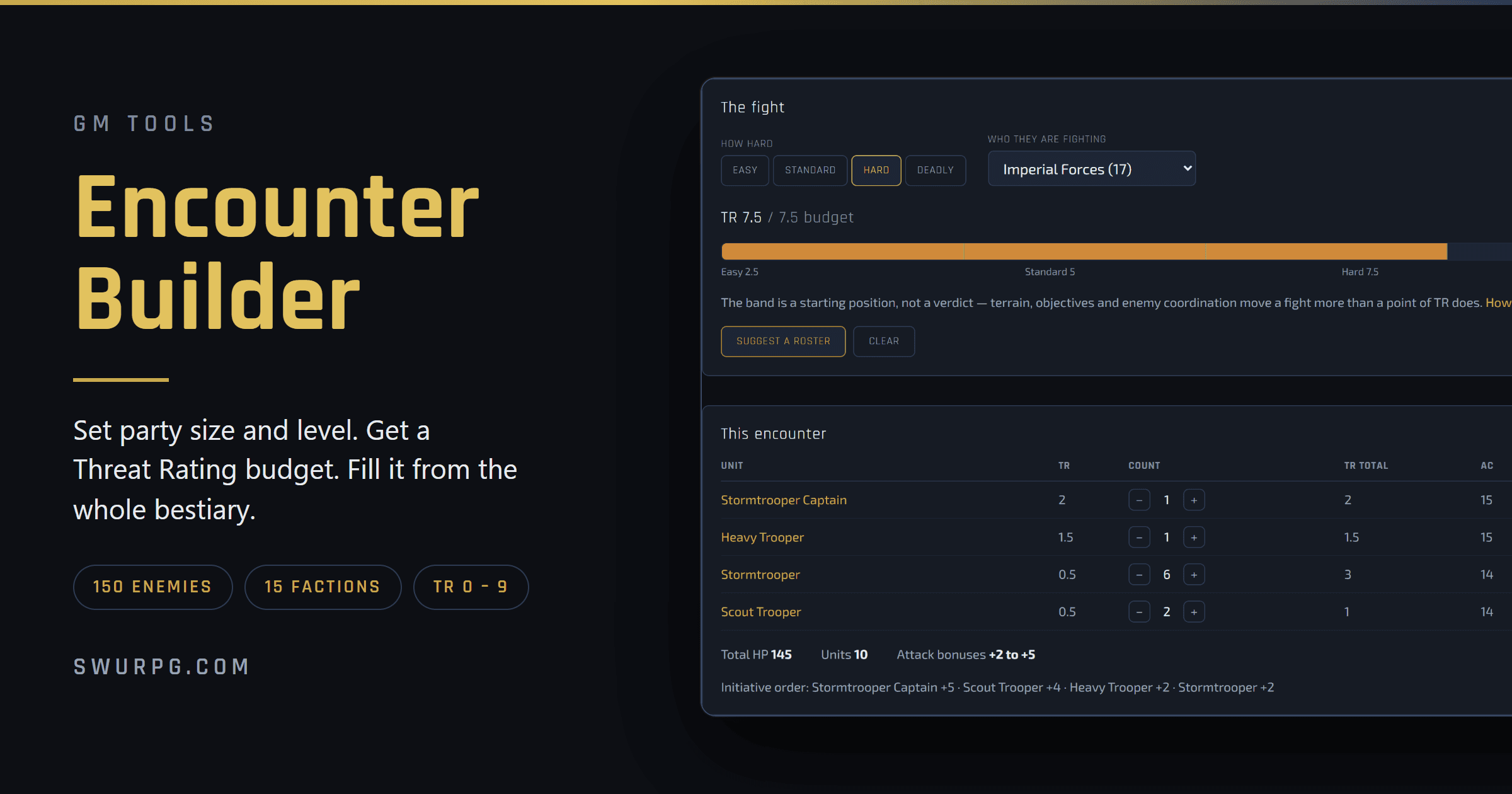
The napkin math, done for you
Running a fight in SWURPG means answering one question before the session: is this a scrap or a funeral? The GM Guide gives you the rule — every enemy carries a Threat Rating, and you compare the sum of the TRs in the scene against your party's average level. Easy is about half the party level, Standard about equal to it, Hard about one and a half times, Deadly twice or more.
Simple enough to do in your head, right up to the moment you have a Nihil marauder, two cloud-riders and a pack of vulptices on the table and you are trying to remember whether the fifth player bumps you a level. So here is the tool: the Encounter Builder.
Tell it four players at level 5. It hands you four budgets:
| Band | Multiplier | Budget |
|---|---|---|
| Easy | 0.5 × PL | 2.5 |
| Standard | 1 × PL | 5 |
| Hard | 1.5 × PL | 7.5 |
| Deadly | 2 × PL or more | 10 |
Pick a band, add enemies, and a meter tracks the spend while the header tells you which band the total actually landed in — not always the one you asked for.
The party-size tweak, applied for you
The published rule has a shortcut for tables that are not four players: with three, treat the party as one level lower; with five or more, one level higher. The builder applies that before anything else, and says so on screen rather than quietly adjusting the number behind your back.
Three players at level 5 get budgeted as level 4, so Hard becomes 6 instead of 7.5. Six players at level 5 get budgeted as level 6, and Hard becomes 9. Same rule you would apply by hand. It just does not get forgotten at 11pm on a Tuesday.
Why Hard is a band and not a line
The rule says total TR approximately equals the multiplier, and that word is doing real work. A total of 7.4 against a Hard budget of 7.5 is a Hard fight, not a near miss. So the band boundaries sit at the midpoints between adjacent budgets rather than on the budgets themselves: for that level-5 party, anything from 6.25 up to 8.75 reads as Hard, and 8.75 or more reads as Deadly.
It will also tell you when the arithmetic and the table disagree. The rulebook's own worked example makes the point — a level-4 party against one stormtrooper captain plus four stormtroopers totals TR 4, which is Standard by the numbers and plays closer to Hard, because the captain makes everyone else more accurate. The builder shows you the band. It does not pretend the band is the whole truth.
150 stat blocks, grouped by who they are
The picker holds every statted enemy in the bestiary — 150 units across 15 factions, TR 0 up to TR 9 — and groups them by faction, because that is how you actually think about a scene. You are not shopping for "something around TR 2," you are staffing an Imperial checkpoint or a Pyke spice den.
- Imperial Forces — 17 units, TR 0.25 to 9
- Creatures & Wildlife — 33 units, TR 0 to 8, the deepest bench on the site
- Death Watch — 5 units, and nothing below TR 4
- Sith Order — 6 units, starting at TR 2
- …plus the Republic, Nightsisters, Geonosians, Black Sun, the Hutt Cartel, the Droid Gotra, the Bounty Hunters' Guild, the Nihil, the Pyke Syndicate, the underworld, and loose droid enemies.
Filter to one faction and the budget meter stays put, so you can see at a glance whether that faction can even fill the fight you have in mind.
Suggest a roster
There is a button that fills the budget for you, and it is opinionated about shape rather than just arithmetic. Two rules keep it honest:
- A lead unit may not cost more than 60% of the budget, so you get a leader and some minions instead of one enormous thing standing alone.
- No more than 8 copies of any single unit. Forty stormtroopers is an arithmetically correct Deadly encounter for a level-20 party and a miserable evening of rolling.
The lead cap has an escape hatch, because some factions are elite-only. Ask for Hard against Death Watch at level 5 and the cap allows a lead of 4.5 — but Death Watch's cheapest unit is TR 4, so the cap strands 3.5 of a 7.5 budget and hands you a Standard-weight fight under a Hard heading. When the cap leaves more than a quarter of the budget unspent, the suggester drops it and tries again. Against Death Watch it then reaches for the TR 7 unit, and you get the fight you asked for.
Whatever it gives you is a starting point, not a verdict. Every row has plus and minus buttons.
Bring your actual party
The budget is built from party level, because level is what the published rule balances on. But gear in SWURPG is a story gate rather than a level gate, so two level-5 parties can sit four points of armor class apart depending on what they have looted. The budget must not move for that. You should still get to see it.
So you can load the real party. Two ways in:
- A share link. A player flips the share toggle on their own character and sends you the link; you paste it. This works across accounts, and a character shared this way is reachable by link only — it does not appear in the community gallery.
- Your own saved characters. Sign in and pick them off a list.
Either way the builder reads level, AC and HP off the sheet and averages the levels, with the arithmetic on screen: a party of 3, 3, 4 and 5 averages 3.75 and budgets at 4. You can also type the numbers yourself and the party stays loaded — it just stops driving the budget.
Then it reports what the encounter you built does to those actual numbers:
These enemies attack at +2 to +5. Against your average AC 17, roughly 40% of attacks land — about 23 damage per round across the party.
Hit chance is a plain d20 check, nothing hidden: an attack at +5 against AC 17 needs a 12 or better, which is nine faces out of twenty, so 45%. A natural 1 always misses and a natural 20 always hits, so no figure reads below 5% or above 95%.
Two honest limits, both stated in the panel rather than buried in a post. It counts attack rolls only — a clone trooper's frag grenade is 3d8 to everyone in a 15-foot radius and carries no attack roll, so it contributes nothing to that damage number, and the panel tells you how many actions it had to leave out. And it names your squishiest character next to their HP instead of averaging them away, because the average is not the one who goes down.
None of this changes the budget. It is advisory, and labelled as such on screen.
It is a link, not a session
Encounter state lives in the URL. Party size, level, difficulty and the roster all ride in the address bar, so a fight you prepped on Sunday can be bookmarked, pasted into your notes, or handed to a co-GM. The party itself stays on your machine and never goes into that link — who is playing is not part of the encounter.
Or read the GM Guide first if you want the TR system in full, then come back and let the tool do the multiplication.