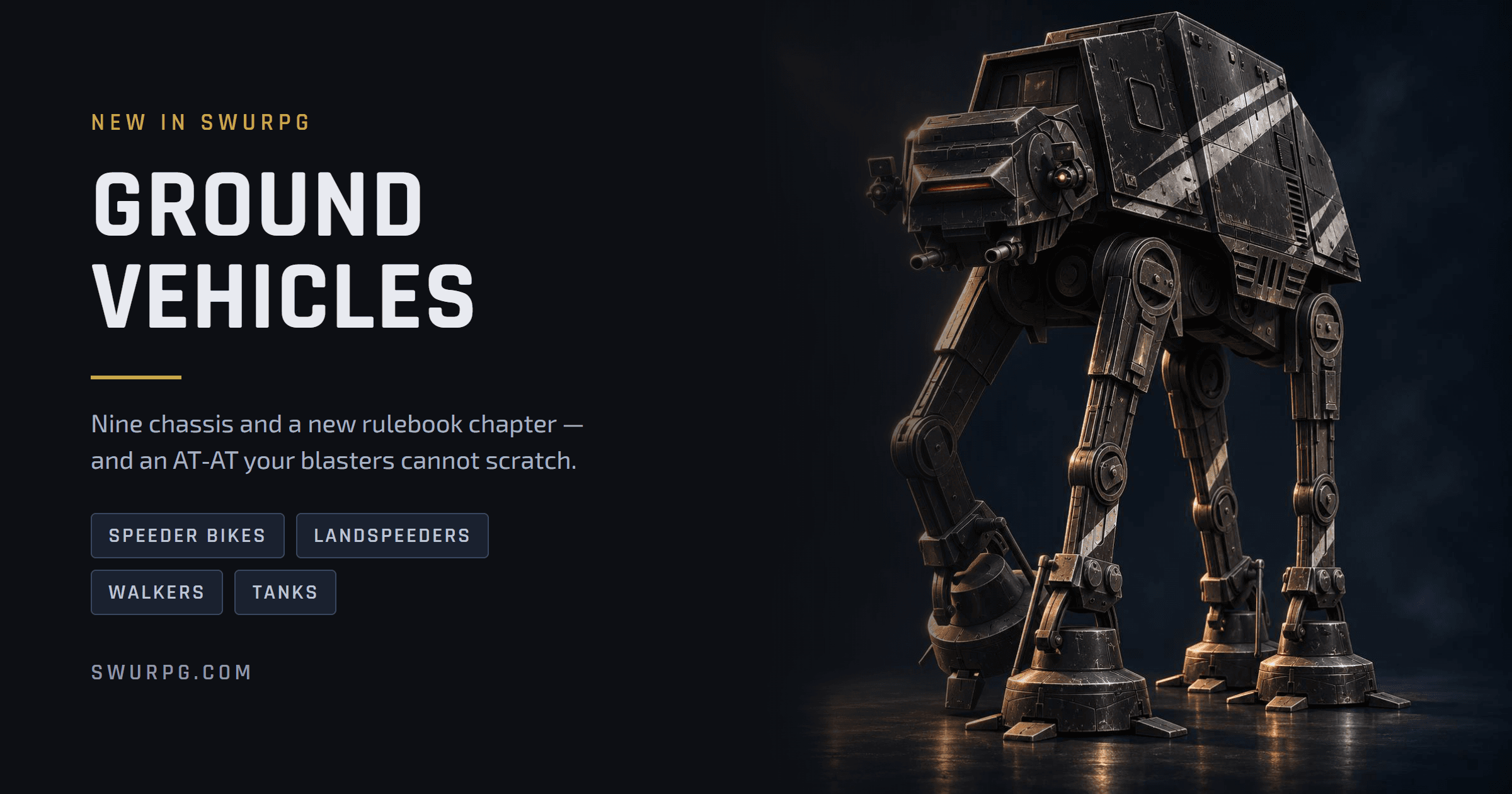
Why your blaster does nothing to an AT-AT
Two things are live this week: a ground-vehicle catalog with nine chassis in it, and a new rulebook chapter — Vehicles and Mounted Combat — covering riding, cover, ramming, crashes, hazards and living mounts.
The catalog is the part you browse. The chapter is the part that decides what browsing it means. And one column in every stat block shaped both.
An AT-AT has Damage Resistance 18. Damage Resistance is flat: subtract it from every hit the vehicle takes, minimum zero. The Heavy Blaster Cannon, the heaviest personal weapon in the game, averages 16. A blaster rifle averages 7.
Both of those come out at zero.
Not reduced. Not a long fight. Zero, every round, however many troopers are firing and however long they keep it up. "That armor's too strong for blasters" is a line a character says in 1980, and now it is a line the stat block enforces.
Ion is the exception, and that is the point. Ion damage ignores a vehicle's Damage Resistance completely. An ion grenade is a serious answer to an armored vehicle in a way a rifle will never be — which is how ion weapons work everywhere else in the galaxy, so it would have been strange to make vehicles the one place they didn't matter.
Riding costs you nothing
There is no vehicle proficiency. No trait to spend, no trained-versus-untrained split, nothing to unlock. Any character can get on a speeder bike and ride it.
The vehicle's Speed replaces yours, and that is the whole transaction. You keep your Action, your Bonus Action and your Reaction. You are a character who moves faster — not a character who gave something up for the privilege.
Pilot is the skill for doing it well: a hard turn at speed, a hazard, a swoop pulled off a rack mid-chase. A character without Pilot proficiency just rolls without the bonus. The skill is about competence, never permission.
The one thing that genuinely costs you is Full Throttle — an Action to move double the vehicle's Speed, at the price of Disadvantage on every Pilot and hazard check until your next turn. Burning your Action to cover ground means you aren't shooting, and the terrain picks exactly that moment to stop forgiving you.
Nine chassis, and the only column that matters
| Vehicle | Category | Size | AC | HP | Dmg Res | Speed | Cover |
|---|---|---|---|---|---|---|---|
| Zephyr-G Swoop | Speeder Bike | Large | 13 | 20 | 0 | 90 ft | +0 |
| 74-Z Speeder Bike | Speeder Bike | Large | 13 | 25 | 1 | 100 ft | +0 |
| BARC Speeder | Speeder Bike | Large | 12 | 30 | 1 | 105 ft | +0 |
| STAP-1 | Speeder Bike | Large | 12 | 15 | 0 | 95 ft | +0 |
| X-34 Landspeeder | Landspeeder | Large | 11 | 35 | 2 | 70 ft | +2 |
| Bantha-II Cargo Skiff | Landspeeder | Huge | 9 | 45 | 2 | 60 ft | +0 |
| AT-ST | Walker | Huge | 14 | 110 | 8 | 40 ft | +5 |
| AAT Battle Tank | Military Vehicle | Huge | 13 | 180 | 12 | 30 ft | +5 |
| AT-AT | Walker | Gargantuan | 13 | 350 | 18 | 30 ft | +5 |
Look at the AC column. It spans 9 to 14 — from a cargo skiff to a scout walker, across the entire catalog. A walker is not meaningfully harder to hit than a speeder bike. Something the size of a building is an easy target; that is why the AT-AT sits at 13 and the Gargantuan size penalty is doing real work.
Now look at Damage Resistance. 0 to 18. That is the difficulty curve, and it is the one you plan an encounter against. A blaster rifle averaging 7 damage does full value to a swoop, 7 to a speeder bike minus 1, and absolutely nothing to the bottom two rows.
The swoop is worth a second look, because it is the catalog's sharpest trade. It is the slowest of the four speeder-class vehicles — 350 kph against the 74-Z's 500 — and it has the best Handling of anything here at +4, with zero armor and the fewest hit points. Canon describes swoops as prioritising engine power over rider safety and ease of handling. The stat line says the same thing without needing the sentence.
Cover is printed on the chassis
Rider cover isn't argued about at the table, because the number is in the stat block: +0 for an open frame, +2 cowled or half-enclosed, +5 fully enclosed and firing from inside. Terrain cover stacks on top of it as normal, so a rider who tucks in behind a rock outcropping gets the rock as well as the chassis.
A living mount gives +0, and that trips people up. You sit on a dewback, not behind it. What actually absorbs fire on your behalf is an enemy choosing to shoot the animal instead of you — and that is target selection, not a cover bonus. The two get confused constantly. They are not the same thing.
Ramming reuses a table we already had
A vehicle driving into something is a large object hitting a target at speed, so ramming reads its damage off the existing Improvised, Thrown and Falling Objects guideline, by the rammer's size: Large 3d6, Huge 4d6, Gargantuan 5d6 or more.
That table already listed "swoop bike" and "landspeeder" by name, years before any of this had rules. It was always the right table. Both parties to a collision normally take the damage, unless the size gap makes that silly — an AT-AT stepping on a swoop is not a mutual event.
What else is in the chapter
Vehicles and Mounted Combat went into the rulebook as v2.6, and it carries the parts that don't fit a catalog listing:
- A 1d8 vehicle hazard table — sharp turn, heavy traffic, a collapsed stall, a narrow passage, a jump, enemy interference, fire, crowd panic. DCs are GM-set, suggested 10 to 18. Don't roll one every round; one or two is what turns a chase from a comparison of movement rates into a scene.
- Staying aboard. Take damage while riding and you make a DC 13 Dexterity saving throw or come off — Prone, plus falling damage scaled to the drop. It's the same save a jetpack user makes when they're hit in the air, and it applies to everyone equally. A consequence of riding, not a punishment for being untrained.
- Terrain. A repulsorlift vehicle floats over ground-based difficult terrain, gaps and low obstacles the way a flyer does. A walker does not. Legs are the price of armor.
- Living mounts. A mount acts on the rider's initiative and can move or attack on its turn, never both — otherwise riding would be a free extra attack every round and strictly better than walking.
- Statting your own, for the GM who wants the landspeeder their campaign actually needs.
One more seam worth knowing: all six playable chassis here have a single crew station, so a rider uses the ordinary character action economy. The AT-ST, AAT and AT-AT have two or more, so they use crew roles — Pilot, Gunner, Commander — with range bands read as street blocks instead of kilometres. That single distinction is what lets a speeder bike and a walker be one system.
Go for the legs
Which leaves the obvious question. If an AT-AT can't be shot down, how does anyone beat one?
The same way they did on Hoth. The walker's own stat block says it: an AT-AT is brought down by binding its legs, not by damaging it. A tow cable, a winch, a felled mass, anything that entangles both forelegs forces a DC 20 save. On a failure it falls, takes 5d6, and on a roll of 15 or higher on that damage it is destroyed outright.
You will not out-shoot it. You have to think of something.
Nine chassis are live in the vehicle catalog, with full lore, armament and special conditions on every one. The mechanics behind them are in Vehicles and Mounted Combat.